
Profile · July 25, 2026 · 7 min · By Lavinia Crosswell
The Bulge Below the Jawline That Filler Cannot Fix: A Four-Finger Test for What You Are Actually Feeling
There is a soft swelling just behind the jaw angle that gets injected, dissolved, frozen, and lipo'd, and it is none of those tissues. It is a salivary gland, and it is one of the few structures under the jaw that no injectable can address.
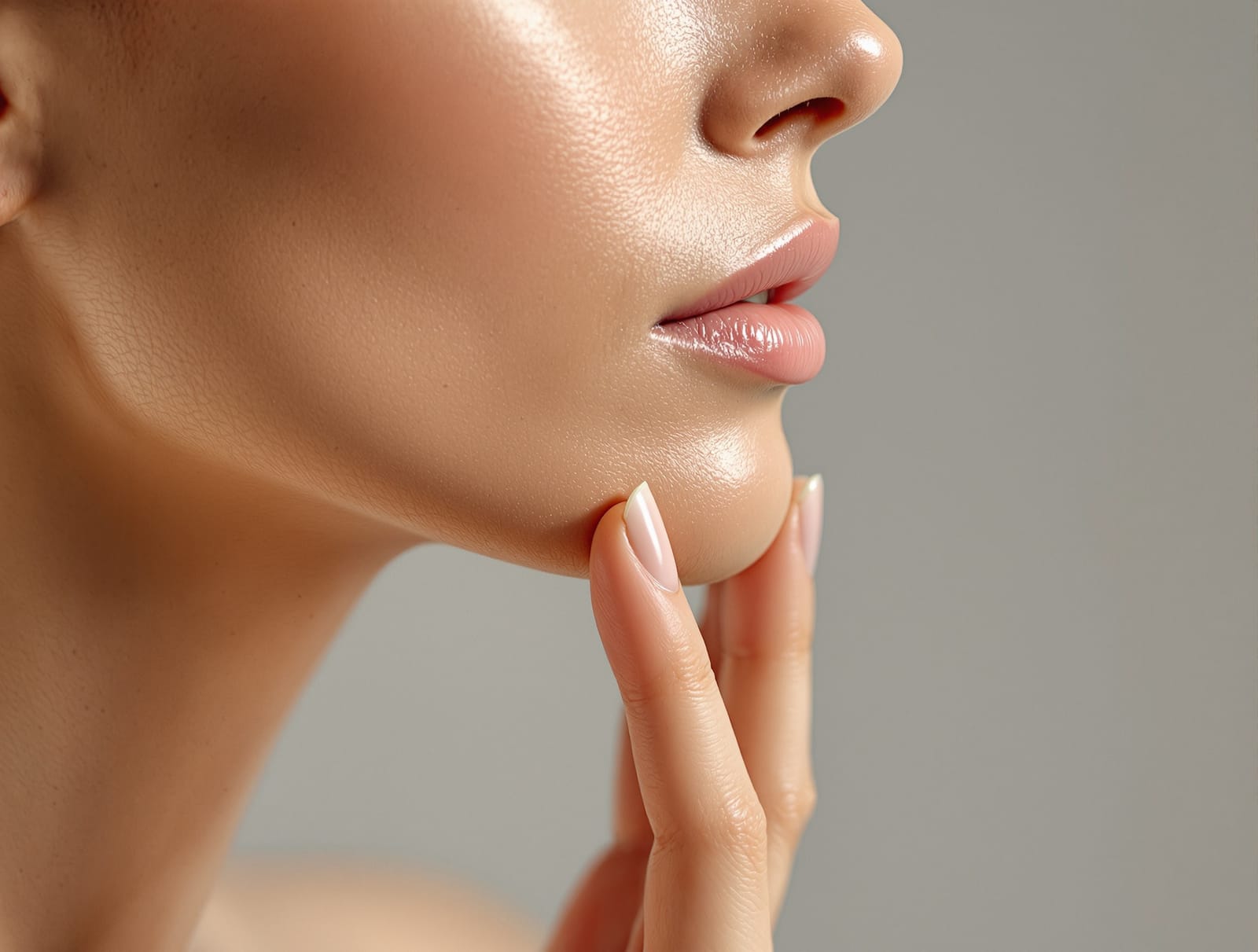
The original element in this article is a four-finger palpation sequence: a self-examination you can run in front of a mirror in ninety seconds that distinguishes the four tissues capable of blurring a jawline, and specifically flags the one that no filler, no neurotoxin, and no fat-dissolving injection will improve. This test does not appear in the marketing material for any jawline treatment, for the straightforward reason that a negative result means there is nothing to sell you.
The setup. Stand at a mirror in decent light. Turn your head slightly away from the side you are examining and tip your chin down about fifteen degrees. Place the pads of your fingers, not the tips, along the underside of the jaw, starting at the chin and working back toward the earlobe. You are going to check four things in order. Do both sides, and compare.
One: the fat pad, checked by pinching. Starting under the chin and moving back, pinch the tissue between thumb and forefinger and lift it away from the jawbone. Submental and jowl fat is soft, compressible, mobile, and it comes away in your fingers as a genuine fold. If you can hold a pinchable cushion, that is fat, and it is what fat-dissolving injections and chin liposuction are aimed at.
Two: the skin envelope, checked by lifting. Place two fingers on the skin just behind the jaw angle and draw it gently upward and back toward the ear, then release. If the jawline sharpens dramatically while you hold and softens the moment you let go, and if the tissue you moved was thin rather than cushioned, you are looking at laxity rather than volume. This is the skin quality problem, and it belongs to tightening and lifting approaches rather than to filler.
Three: the masseter, checked by clenching. Place your fingers on the flat of the cheek just above and in front of the jaw angle, then clench your teeth hard. A muscle should bulge firmly under your fingers and relax completely when you unclench. If the width of your lower face is being driven by a large, hard mass that appears on clenching and disappears on release, that is masseter bulk, and it is what masseter treatment addresses.
Four: the gland, checked by the swallow test. This is the step nobody teaches and the reason this article exists. Move your fingers to the soft triangle just below and slightly forward of the jaw angle, between the jawbone and the front edge of the neck muscle. Press gently upward, under the bone. You are feeling for a discrete, smooth, somewhat rubbery, walnut-shaped mass that sits partly tucked under the jaw and does not pinch away from it. Then, keeping your fingers in place, swallow. Then relax your neck completely, then tense it.
Here are the discriminating findings. The submandibular gland is firmer than fat and softer than muscle, it is a defined lump with edges rather than a diffuse cushion, it does not come away when you pinch because it sits deep, beneath the neck muscle rather than above it, it becomes more prominent rather than less when you relax the neck and tip the chin down, and it does not change with clenching. Fat pinches. Muscle appears on clenching. Skin moves when you lift it. The gland does none of these things, and once you have felt the difference it is unmistakable.
Why it matters so much. Because this is the one finding on the list where the standard non-surgical menu has essentially nothing to offer, and where attempting it can make things worse. Filler placed along the jawline builds projection at the border of the bone. If the shadow you dislike is a gland sitting below and behind that border, adding filler above it can sharpen the contrast and make the bulge more visible, not less. Fat-dissolving injection is aimed at subcutaneous fat and has no useful action on glandular tissue; injecting a deoxycholic acid product into or around a salivary gland is not a treatment, it is a complication waiting to happen. Neurotoxin relaxes muscle and does nothing to a gland. Skin tightening tightens the envelope over an unchanged structure underneath.
What the actual options are. Honesty here is more useful than optimism. Submandibular gland prominence is a surgical consideration, and specifically a consideration within neck lift surgery rather than a standalone cosmetic procedure. Partial resection of the gland is performed by surgeons doing deep neck contouring, and it is genuinely part of the modern repertoire: recent work has assessed safety of partial submandibular gland resection in deep neck surgery (Aesthetic Surgery Journal Open Forum), and techniques for partial resection have been described in the plastic surgery literature for over a decade (Plastic and Reconstructive Surgery Global Open). It also carries risks that filler does not, including bleeding, injury to nearby nerves affecting the lip and the tongue, and changes to salivary function. That risk profile is why many experienced surgeons address the gland selectively rather than routinely, and why the honest answer for many people is that the gland stays.
A necessary detour into what is not cosmetic. A lump under the jaw is not automatically a normal gland, and the self-test above is a contouring tool, not a diagnostic one. Certain findings mean you stop reading about jawlines and see a physician instead: a swelling that is new rather than long-standing, one that is markedly asymmetric, one that is painful or tender, one that swells specifically when you eat and then subsides, which suggests an obstructing salivary stone, one that is hard and fixed rather than mobile, or one that is accompanied by a dry mouth, fever, or persistent lymph node enlargement. None of those are contour problems, and none of them are treated by anyone in aesthetics.
What the evidence does not tell you. Two real gaps. First, there is no published prevalence figure for how often visible submandibular gland prominence contributes to an unsatisfying jawline in cosmetic patients, because nobody has counted; what exists is surgical case series and expert opinion. Second, and more relevant to a decision today, there is no validated non-surgical treatment for glandular prominence and no trial has tested one, so any clinic offering to reduce a gland with an injectable is operating well outside the evidence. That is the strongest practical claim this article makes and it is worth stating plainly.
The reframe worth taking away. People arrive at consultations with a photograph and a shadow they dislike, and the conversation immediately becomes which product to use. The more useful conversation starts one step earlier: which tissue is producing the shadow. Fat, skin, muscle, and gland sit within a few centimetres of each other, they produce visually similar results, and they respond to completely different interventions. Ninety seconds with a mirror in front of your first consultation will tell you whether the answer you are about to be sold is aimed at the tissue you actually have.